A Smarter Way to Handle DCCs in Kelowna
The city of Kelowna should allow developers to pay development cost charges (DCCs) after the building is constructed instead of upfront.
Isaiah Paget
TLDR;
The city of Kelowna should allow developers to pay development cost charges (DCCs) after the building is constructed instead of upfront. So that developers don't have to pass the extra financing costs on to buyers and renters.
Development Cost Charges in Kelowna
Development cost charges (DCCs) are a form of tax that municipalities came up with across North America after WW2. This era saw the rapid expansion of city borders, almost every new building had new roads, water/sewage, and electrical infrastructure going to it, and the city thought it was only fair that "growth pays for growth" so in order to cover the capital cost of this new infrastructure, Kelowna adopted the DCC.
It made sense at the time because the new infrastructure was primarily used by the people of that new neighbourhood. However today, we have hit our limit on continuous suburban expansion and that's not because of a shift in culture or preference for urban living. Kelowna is staring at a multi billion dollar infrastructure deficit. In English that's infrastructure that needs repairs but those repairs are being delayed because the funding isn't there. This is a problem because if we keep putting it off - one day the infrastructure will fail, the worst of this would look like sewage spills, bridges falling down, etc. 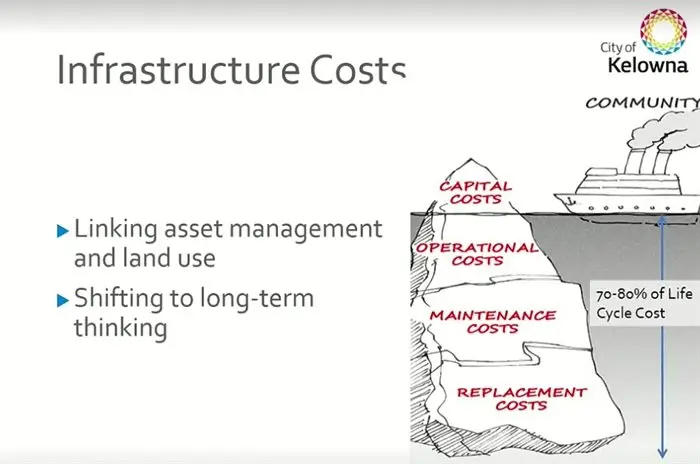 In the graphic above, DCCs cover only part of the capital cost, which is the smallest portion of the life-cycle cost of city infrastructure.
Despite new infrastructure not being required for infill projects, the city of Kelowna still imposes DCCs: to the tune of about $28,000 per unit. To put that in perspective, a 25-year mortgage on $28,000 dollars of tax at 4% interest with 20% down adds about $118 per month to housing costs. Buying a new build means paying that extra amount on your mortgage or having the costs passed down from the landlord to the tenant through higher rent.
Kelowna reduces development cost charges to get more houses built
In April 2026, Kelowna City Council cut DCCs by 25%. Although a significant benefit for renters, home-buyers, and construction workers. This decision has sparked debate among council members about how the city will fund the resulting revenue shortfall. At Strong Towns Kelowna, we are strongly opposed to DCCs and think they should be abolished. We do not think it is fair to require new entrants to the market to pay more for public services that all residents use. We believe public infrastructure should be funded through general property taxes.
That said, there is a way for Kelowna to further reduce the burden of DCCs on consumers without losing revenue. Currently, builders must pay these charges upfront, meaning the cost is rolled into their initial construction loans. These loans can carry interest rates as high as 15% per year until the project is completed. As a result, a $28,000 charge can grow to roughly $43,000 over three years of construction.
If the city instead allowed payment to be deferred until after construction is complete, it would still receive the original $28,000. The difference is that builders (and ultimately residents) would not be paying thousands in interest to the bank. This issue is even more pronounced in projects that face long, multi-year approval processes before construction can begin.
One concern is that the city would face an opportunity cost, since it would receive the funds later, potentially a year or more after project approval. However, in practice, Kelowna does not typically deploy DCC funds immediately or in direct coordination with individual developments. Instead, these funds are often held and allocated to future infrastructure projects, sometimes on timelines that stretch over a decade. Because of this, deferring DCC collection would have minimal practical impact on the city’s ability to fund infrastructure, while significantly reducing financing costs for new housing.
Policy recommendation
Delay the collection of development cost charges (DCCs) until after construction is complete.