Brady Rogers 2026
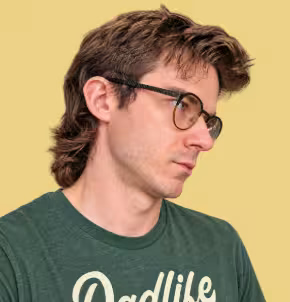
Brady is a former robotic automation engineer and the co-founder of The Rogerie, a Kelowna company that turns locally recovered plastic waste into new products. What began in 2019 in his laundry room now operates from a storefront in downtown Kelowna.
Isaiah Paget
1. Do you think our main street/downtown is healthy and successful? If not, what would you do to change that?
Overall, yes, I think our downtown is successful. I enjoy spending time there and there's a lot that's working. But ‘successful’ depends on what we're measuring. Businesses dealing with theft or open drug use may understandably answer differently than I would as a visitor. I'd like to see us protect what works while being much more responsive to the specific problems businesses and residents are identifying.
2. What’s more important for our city right now: building new homes and commercial space or rehabbing/expanding/better utilizing our existing homes and storefronts?
Both. Kelowna needs substantially more housing as our population grows, but we should also make better use of the buildings and land we already have. That's one reason I'm interested in land-value taxation: shifting some taxation away from buildings and improvements and toward underlying land could reduce the penalty for improving property while encouraging valuable urban land to be used more productively.
3. How do you feel about the transportation options currently available in our city? Can all of our residents affordably get where they need to go? If not, what will you do to improve transportation in our city?
I can't speak for every resident, but clearly not everyone can affordably or efficiently get where they need to go. For starters, we need the operational capacity to add more buses. More importantly, we should focus on making transit fast, frequent and reliable enough that people can actually depend on it, rather than simply covering a map with routes. Transit that lets even some households go from two cars to one, or one to none, is both transportation infrastructure and affordability infrastructure.
4. Some people in our community say that we have traffic problems. What do you think? How would you mitigate those concerns or change the situation?
100% agree. Driving in Kelowna can be a pain. We can't solve congestion indefinitely by accommodating more cars. I want transit that's fast and reliable enough that more households can realistically go from two cars to one, or one to zero. Every trip shifted to transit is one less car contributing to congestion, and reducing car ownership can also save households thousands of dollars a year.
5. If you could change one thing in our zoning code, what would it be and why?
I don't currently have a specific provision of Kelowna's zoning bylaw that I'd change, and I'd rather say that than invent one for a questionnaire. My bigger interest around zoning is what happens when a City decision dramatically increases a property's value. I think we should better understand how much value our rezoning decisions create and make sure the public captures a reasonable share of that value to help pay for the growth it enables
6. How do you plan to involve residents in the decision making process in our town?
Social media has actually been a fantastic tool for hearing directly from residents during this campaign. Longer term, I'd love to see a much better centralized online hub where residents can easily understand upcoming decisions, see the reasoning and evidence behind them, answer surveys, submit ideas and follow what happened afterward. Public engagement shouldn't just mean holding an open house and checking a box.
7. If someone came to you with a proposal to build a new piece of public infrastructure in our city (road, bridge, etc.), how would you evaluate whether or not that project was worth implementing?
My first questions would be: what problem does this solve, how much benefit does it provide, how many people benefit, and what does it cost relative to the alternatives? Then I'd ask who should reasonably pay for it. If new growth creates the need for infrastructure, I think that growth should contribute appropriately rather than automatically pushing the entire cost onto existing taxpayers.
8. If elected, what three steps would you take to put our city on a firmer financial footing?
First, and most obviously, consider the city's budget, and ensure that the various departments are spending money on things that deliver value to the taxpayer - do taxpayers derive a beKelowna is not a city in obvious financial crisis, so I don't think the answer is inventing three arbitrary cuts. I'd focus on better transparency around spending and value-for-money, ensuring growth pays an appropriate share of the infrastructure it requires, and strategically acquiring appreciating public assets like land. As Kelowna grows wealthier, I'd like the City to build public wealth alongside it rather than only facing increasingly expensive future land purchases
9. If you received a $1 million grant to use for the city any way you wanted, what would you do with it and why?
I'd probably spend it on a collection of small, boring improvements residents have been waiting years for: lighting, sidewalks, safer crossings, public spaces and other neighbourhood fixes. I'd ask residents and businesses to identify candidates, have staff cost the feasible ones, and let the public help prioritize them. $1 million won't transform Kelowna, but it could fix a surprising number of irritating little problems.
10. What neighbourhood do you live in? Why? Where are your favourite places to spend time in our town?
I live in North Clifton because I found an affordable place to rent close to my family. When I go out, I probably spend the most time downtown or around City Park. One of my favourite things about Kelowna is being able to go from downtown restaurants and shops to the lake and parks within a few minutes.