Indy Dhial 2026
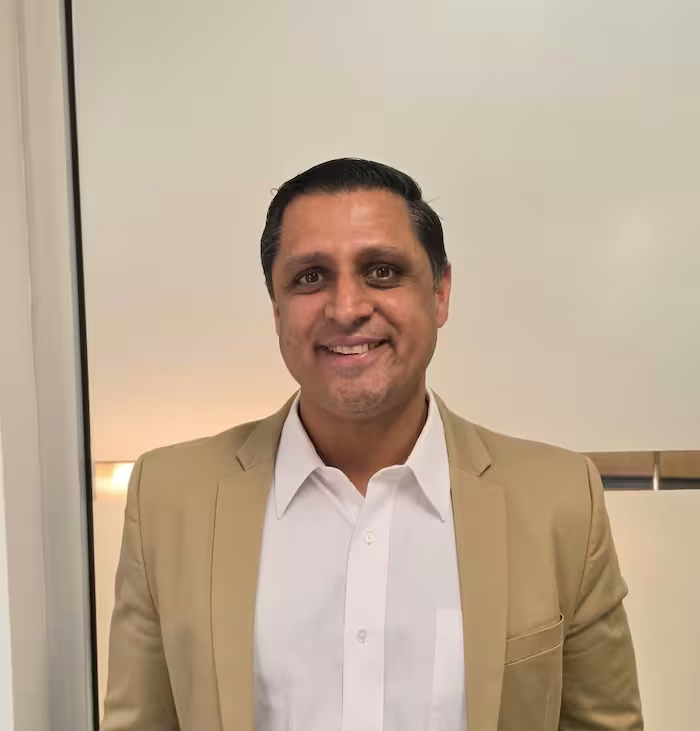
Raised in Kelowna, Indy Dhial has proudly called Kelowna home for more than 40 years. His experience spans business, governance, education, and community leadership. After 15 years with Shaw Communications, Indy became Regional Sales Manager, leading strategic partnerships and working with businesses and community organizations across British Columbia. He went on to become an Early Childhood Educator and founded TGP Kids, where he serves as Founder & CEO.
Isaiah Paget
1. Do you think our main street/downtown is healthy and successful? If not, what would you do to change that?
Downtown has many successful businesses, events and public spaces, but concerns about safety and accessibility are affecting our willingness to visit. I would strengthen partnerships among businesses, community organizations, bylaw officers and the RCMP while
supporting outreach that connects people with appropriate services. We must also improve accessibility to pedestrians, cyclists, transit users and drivers. Its success depends on people feeling safe, welcome and able to support local businesses all year.
2. What’s more important for our city right now: building new homes and commercial space or rehabbing/expanding/better utilizing our existing homes and storefronts?
Kelowna needs both, but we should begin by making better use of existing homes and vacant storefronts. Infill options and redevelopment can add housing and business opportunities without continuously extending expensive infrastructure. New construction will still be necessary as Kelowna grows, particularly along suitable transportation corridors. Development must be supported by adequate infrastructure and public services. The goal is not simply more construction, it should be affordable and well-planned communities built for today and the future.
3. How do you feel about the transportation options currently available in our city? Can all of our residents affordably get where they need to go? If not, what will you do to improve transportation in our city?
Kelowna’s transportation system is not meeting everyone’s needs. Transit must be reliable, frequent, safe and accessible, particularly for workers, students, seniors and residents outside the urban core. I would support our transit drivers, improve service on high-demand routes and plan for the needs of Kelowna years from now. Walking and cycling connections should be reviewed alongside traffic flow, parking and accessibility. Better options matter, but we must recognize that many families and workers will continue to depend on private vehicles and the parking that comes with it.
4. Some people in our community say that we have traffic problems. What do you think? How would you mitigate those concerns or change the situation?
Kelowna has real traffic challenges caused by rapid growth, limited routes and infrastructure that has not always kept pace. We cannot solve congestion through one type of transportation alone. I would prioritize upgrades at known bottlenecks, protect and acquire space for future road improvements and coordinate transportation planning with new development. Reliable transit and safe walking and cycling connections can reduce pressure on our roads, but projects must also consider vehicle traffic, commercial deliveries, emergency access and parking. We need a balanced system that works for how residents actually travel.
5. If you could change one thing in our zoning code, what would it be and why?
I would improve the connection between zoning decisions, the Official Community Plan and available infrastructure. Residents, property owners, and builders should have confidence that the OCP provides a dependable direction for growth. Changes will sometimes be necessary, but they should be supported by clear evidence, meaningful consultation, and an understanding of impacts on surrounding neighborhoods. Before approving additional density, we must know that transit, infrastructure, and public services can support it. Predictable zoning encourages investment while protecting public confidence.
6. How do you plan to involve residents in the decision making process in our town?
Good leadership starts with listening. I would remain accessible through community meetings, neighborhood visits, telephone calls and regular conversations with residents, businesses and community organizations—and I will return your phone calls. Public engagement must happen early enough to influence a decision, not after the direction has effectively been chosen. I would explain the options, costs and trade offs in plain language and report back on what was heard. Residents may not always agree with the final decision, but they deserve to know their concerns were genuinely considered.
7. If someone came to you with a proposal to build a new piece of public infrastructure in our city (road, bridge, etc.), how would you evaluate whether or not that project was worth implementing?
I would begin by identifying the problem the project is intended to solve and whether it reflects Kelowna’s most pressing needs. I would examine the full construction cost, available funding, long term maintenance obligations, environmental effects and impacts on residents and businesses. I would also compare it with less costly alternatives and consider whether it supports future growth, public safety and the OCP. A project should proceed when its long term community value justifies both its immediate cost and long term financial responsibility.
8. If elected, what three steps would you take to put our city on a firmer financial footing?
First, I would review major spending and infrastructure commitments to ensure they address clear priorities and include their complete long term operating and maintenance costs. Second, I would strengthen performance reporting so Council and residents can see whether programs are producing measurable results. Third, I would expand Kelowna’s economic base by supporting local businesses and attracting investment in sectors such as aerospace, technology and agri-tech. Strong finances require disciplined spending, sustainable growth and a local economy capable of supporting career oriented jobs.
9. If you received a $1 million grant to use for the city any way you wanted, what would you do with it and why?
I would use the $1 million to launch a centralized intake system for people experiencing homelessness, addiction, or mental-health challenges. A single point of contact would assess each person’s needs, connect them with the right treatment and support programs, and help secure safe housing after recovery. By coordinating existing providers rather than duplicating services, this investment would close gaps, create a clearer path from crisis to stability, and improve community safety.
10. What neighbourhood do you live in? Why? Where are your favourite places to spend time in our town?
I live in Rutland, a diverse and hardworking community with a strong sense of identity. It is where I operate my childcare business, volunteer, coach and work alongside families, young people and local organizations. Some of my favorite places are the Rutland Sports Fields, YMCA and many of our unique food options. Rutland represents much of what I love about our city - community pride, opportunity and people who care about one another.