Kevin Kraft 2026
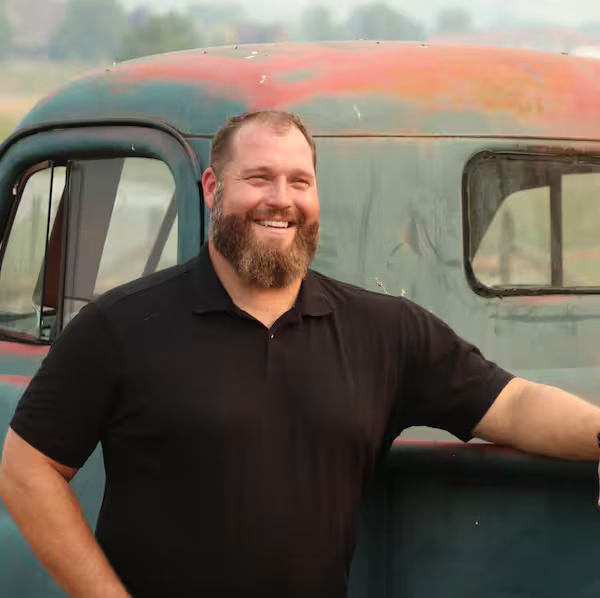
Kevin Kraft is a father, farmer, educator, former firefighter, business owner, and experienced community leader who has spent his life in the Okanagan. He currently serves as the East Electoral Area Director for the Regional District of Central Okanagan, where he has served as Vice Chair of the Regional Board and is currently Chair of the Electoral Area Services Committee.
Isaiah Paget
1. Do you think our main street/downtown is healthy and successful? If not, what would you do to change that?
I believe two things can be true: Kelowna has a healthy and economically important downtown, and it can be better. Businesses, tourism, and investment have made downtown a focal point for decades. However, concerns around street disorder, addiction, vandalism, and public safety are affecting how families, businesses, and visitors experience it. Kelowna’s growth has also outpaced investment in policing, fire, EMS, and other services. I would focus on improving public safety, supporting businesses, addressing street-level challenges, and creating a downtown that is vibrant, welcoming, and economically productive.
2. What’s more important for our city right now: building new homes and commercial space or rehabbing/expanding/better utilizing our existing homes and storefronts?
Kelowna needs new homes and a diverse range of housing options, but we should also make better use of the homes, commercial spaces, and infrastructure we already have. Our current real estate inventory presents interesting challenges, so both can be important at the same time. I am not the biggest fan of more “boxes in the sky” as the primary option for families and people who want to call Kelowna home. I support practical infill and incremental development where it makes sense, while ensuring growth does not simply create additional pressure on infrastructure and taxpayers. Commercially, we need the right types and sizes of spaces to support local businesses and investment.
3. How do you feel about the transportation options currently available in our city? Can all of our residents affordably get where they need to go? If not, what will you do to improve transportation in our city?
Kelowna has a solid foundation of transportation options, including transit, taxis, and rideshare, but access is not equal across the community. I live on a route with limited daily service, so I understand the challenge firsthand. I would look at improving connections from outlying areas to more frequent and rapid transit routes. However, expanding service comes with costs for taxpayers and users, so investments need to be tied to measurable improvements. We also need to address congestion, because traffic impacts buses, emergency services, taxis, rideshare, and everyone trying to get around our city. Time is money or cost, in this regard.
4. Some people in our community say that we have traffic problems. What do you think? How would you mitigate those concerns or change the situation?
We have a traffic problem, full stop. As a parent, I experience it daily during school, rush hour, sports, and our busy summer season. Better construction planning and project timing can reduce unnecessary congestion, but we also need to address fundamental bottlenecks. Highway 97 and 33 are provincial responsibilities, but Kelowna can still advocate for improvements and make local changes. 24hr Sensor-activated left-turn lanes, reducing unnecessary commercial access directly from highways, improving intersection functionality, and evaluating the HOV lane are practical steps that could improve traffic flow without simply building more roads.
5. If you could change one thing in our zoning code, what would it be and why?
Identifying a particular zoning example would have been helpful for this question. I would expand opportunities for smaller, family-oriented housing forms within existing neighbourhoods. Kelowna needs more attainable options between a large single-family home and a condo, including smaller detached homes, duplexes, and appropriately scaled townhomes. I support incremental density, but I believe scale and neighbourhood context matter. Six units replacing one home can look and function very differently depending on the design and location. I would like zoning to provide more flexibility for diverse housing while maintaining practical expectations around parking, infrastructure, neighbourhood character, and livability.
6. How do you plan to involve residents in the decision making process in our town?
My approach is simple: listen first, be accessible, and use experience and evidence to make good decisions. If elected, I will be fully committed to the role and available and accessible to constituents. I also believe transparency means residents should have a clear understanding of how and why decisions are made. I would like to see more significant files and decisions come before council for public discussion and debate, rather than being resolved solely through staff processes. Staff expertise is essential, but elected councillors are accountable to residents, and council should have an appropriate role in meaningful decisions that shape our community.
7. If someone came to you with a proposal to build a new piece of public infrastructure in our city (road, bridge, etc.), how would you evaluate whether or not that project was worth implementing?
I would start with three questions: What problem are we solving, what will it cost to build and maintain, and what measurable benefit will residents receive? I would consider the full lifecycle cost, including operations, maintenance, replacement, and future infrastructure obligations. I would also ask whether we have fully utilized or improved the infrastructure we already own before adding more. A project should not move forward simply because funding is available. It should demonstrate clear community value, financial sustainability, and a realistic long-term plan for maintaining the asset. A final consideration is the projected timeline and construction impacts on other existing infrastructure and users.
8. If elected, what three steps would you take to put our city on a firmer financial footing?
First, establish clear strategic priorities for the four-year term, with community, staff, and council input, and align spending with those priorities based on the existing capital plan. Second, conduct an independent review of municipal operations to identify opportunities for greater efficiency and ensure departments and services are delivering value. Third, evaluate major capital projects based on their full lifecycle costs—not just the cost to build them—including long-term maintenance and replacement. We need to be disciplined about taking on new obligations and ensure growth and infrastructure decisions improve Kelowna’s long-term financial position rather than simply increasing future costs.
9. If you received a $1 million grant to use for the city any way you wanted, what would you do with it and why?
I would split the $1 million into two $500,000 programs. The first would support community societies, volunteers, and nonprofits already delivering valuable services. The second would help local farmers identify irrigation losses and invest in more efficient systems. On our own farm, improvements to drip irrigation, filtration, and pressure management reduced our water use by nearly 15%. Even $5,000 per farm could help 100 farms make measurable long-term improvements. Rather than putting $1 million into one project, I would use it to leverage existing community efforts and create measurable, distributed benefits.
10. What neighbourhood do you live in? Why? Where are your favourite places to spend time in our town?
I live in the north end of Kelowna, near the airport. It is a quieter, family-oriented community where we enjoy the space, schools, and connection to agriculture while still being close to everything Kelowna offers. As a family, we spend a lot of time in our parks, around the community, and exploring Kelowna’s restaurants and local businesses. We also spend plenty of time at the farm, where we enjoy the work of producing food and contributing to our community. Kelowna offers an incredible mix of neighbourhoods, agriculture, recreation, and natural spaces, and I value all of it.