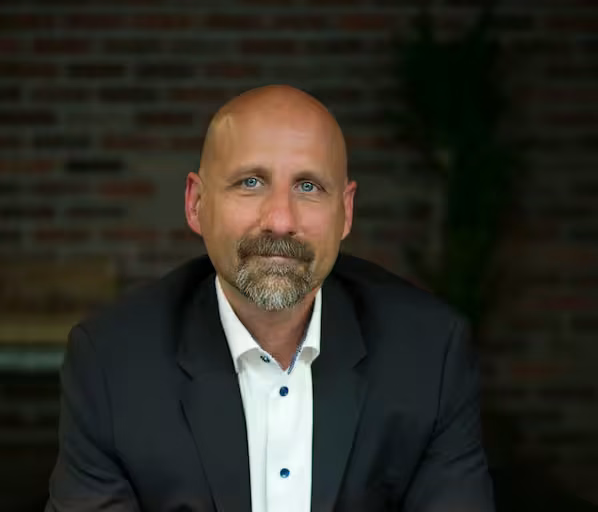
Les Bellamy 2026
Les Bellamy is a Kelowna business owner and community leader who has called the city home since 1989. Over three decades in business, he has managed complex projects, balanced budgets and made decisions where accountability matters. His community involvement includes business leadership, volunteer work and civic advocacy. Having lived in Rutland, the Lower Mission, North Glenmore, the Upper Mission and now downtown, Les understands the different needs of a growing city. He is running for Kelowna City Council in 2026, focused on practical, accountable decision-making, safer streets, housing affordability and responsible growth.
Isaiah Paget
1. Do you think our main street/downtown is healthy and successful? If not, what would you do to change that?
The question is a little unclear. I assume by “main street” you mean Bernard Avenue and, specifically, the seasonal closure to vehicle traffic. “Downtown” is much broader, and I wouldn’t measure the success of the entire downtown by one street or one policy. For Bernard, I’d start by asking businesses for candid feedback, then residents and visitors. I’d also want to know the cost to the City, what measures of success were established when the policy was introduced, and what the economic data has shown year over year. Good policy should be measured against the results it was intended to achieve.
2. What’s more important for our city right now: building new homes and commercial space or rehabbing/expanding/better utilizing our existing homes and storefronts?
I don’t see these as competing priorities. We need new homes and commercial space as our community grows, while also making better use of the buildings and properties we already have. Renovation, redevelopment, additions and adaptive reuse can sometimes be the most practical solution. In other circumstances, new construction makes more sense. City Hall shouldn’t unnecessarily favour one over the other. Our job should be to create sensible policies that allow both, remove unnecessary barriers, and ensure infrastructure and services can support them. The right solution will depend on the property, the neighbourhood and the need.
3. How do you feel about the transportation options currently available in our city? Can all of our residents affordably get where they need to go? If not, what will you do to improve transportation in our city?
I’m not sure affordability alone is the right measure. Walking is free and transit is relatively inexpensive, but that doesn’t make either practical for every resident or every trip. I think transportation spending should reflect how people actually move around our city. Roads, transit, cycling and pedestrian infrastructure all have a role, but every investment should be evaluated against its cost, actual and projected use, year-round practicality and the number of residents it benefits. I don’t think Council should favour one mode of transportation ideologically. We should invest where the evidence shows we can provide the greatest benefit.
4. Some people in our community say that we have traffic problems. What do you think? How would you mitigate those concerns or change the situation?
Kelowna has historically allowed too much infrastructure to arrive years, sometimes decades, after it was needed. Growth is not the problem. Poor planning is. The questions I will ask are: What infrastructure do we need today, what are we currently missing, and how are we measuring that need? What will we need tomorrow, and what data are those projections based on? Most importantly, how do we ensure roads, transportation and essential services are planned, funded and implemented in step with future growth, rather than trying to catch up years later?
5. If you could change one thing in our zoning code, what would it be and why?
I wouldn’t change a zoning regulation simply for the sake of having an answer to this question. I’d first identify which regulations are creating the greatest unnecessary cost, delay or barriers to responsible development, and what public benefit those regulations are providing. I’d also look closely at variance applications. If we repeatedly approve variances to the same setback, parking, site coverage or other requirement, we should ask whether the individual projects are really the problem or whether the underlying regulation needs another look. Zoning should protect the public interest without creating unnecessary barriers
6. How do you plan to involve residents in the decision making process in our town?
Public engagement should happen before major decisions are effectively made, not after. I want residents presented with the problem, the constraints and realistic alternatives while there is still an opportunity to influence the outcome. We should expand neighbourhood and online engagement, use statistically meaningful surveys where appropriate, and actively seek input from people who don't normally participate at City Hall. Most importantly, we should report how many people participated, what they told us, what changed as a result and why. Public engagement should be earlier, broader and measurable.
7. If someone came to you with a proposal to build a new piece of public infrastructure in our city (road, bridge, etc.), how would you evaluate whether or not that project was worth implementing?
I would start by asking five questions: What problem are we solving? What will it cost? How will we measure success? Who is accountable if it doesn’t work? And what project are we choosing not to fund instead? I would also want to understand the long-term operating and maintenance costs, not simply the initial construction cost. Public infrastructure can serve a community for generations, but it also creates financial obligations for generations. Before committing taxpayer dollars, Council should clearly understand the need, the alternatives, the total cost and how we will determine whether the investment succeeded.
8. If elected, what three steps would you take to put our city on a firmer financial footing?
Kelowna is already in a strong financial position, and I think that should be acknowledged. My focus would be on keeping it that way. I would support an independent external review of City operations. Not because I assume something is wrong, but because any organization of this size should periodically look for duplication, inefficiencies and opportunities to do things better. I also want us asking harder questions before we spend money and looking further ahead at the costs our decisions create. Being financially responsible isn’t necessarily about spending less. It’s about making sure we’re spending wisely.
9. If you received a $1 million grant to use for the city any way you wanted, what would you do with it and why?
I’d invest it in better public engagement. Too often we hear from residents after a major decision has already been made, or from a relatively small group who regularly participate in City processes. I’d use the funding to reach a much broader cross-section of Kelowna, through statistically meaningful surveys, neighbourhood engagement and better tools for gathering and reporting public feedback. Most importantly, I’d want residents to see what we heard, what changed because of their input and what didn’t. A million dollars won’t solve our biggest problems, but better information can influence hundreds of millions in future decisions.
10. What neighbourhood do you live in? Why? Where are your favourite places to spend time in our town?
I’ve lived throughout Kelowna since moving here in 1989, including Rutland, the Lower Mission, North Glenmore, the Upper Mission and now downtown. Having lived in such different parts of the city has given me a good appreciation for the fact that Kelowna is not one neighbourhood and the priorities of residents can be very different depending on where they live. I don’t really have one favourite part of Kelowna. I enjoy different areas for different reasons, and I think experiencing the whole city is important for anyone hoping to represent it.